

What creams do dermatologists recommend? Are they familiar with natural cosmetics?
Although we all think dermatologists are experts in natural cosmetics, this is not true.
While this profession is worthy of admiration and their vocation and work are a great gift, dermatologists do not master the natural cosmetics sector. What they usually advise are products from well-known laboratories that, unfortunately, use many chemical ingredients.
Are dermatologists familiar with natural cosmetics?
As a general rule, many dermatologists are unfamiliar with the world of natural, organic, vegan, and cruelty-free cosmetics. And yet, as we have seen in previous articles, these factors largely determine the quality, efficiency, and safety of a cosmetic product.
Why don't dermatologists master the universe of organic and natural cosmetics?
Because they probably haven't studied this field at university. It is not their fault. However, every health professional must be constantly researching and updating themselves: it is an inescapable fact. This allows them to offer valid, efficient, safe, professional, and warm advice.
What dermatologists usually recommend to their patients are products from pharmaceutical laboratories that use synthetic ingredients with harmful preservatives for the body. Studying natural and sustainable cosmetics is, therefore, a pending subject.
We, at Saper, try to do everything possible to provide them with quality, professional, concise, and updated information, but the dermatology and pharmacy sector is very complicated and often they do not show much interest.

What creams do dermatologists recommend?
As far as creams are concerned, dermatologists usually recommend brands such as Bioderma, Avène, Isdin, or Eucerin, for example. They are great pharmaceutical benchmarks, but they contain too many synthetic and harmful ingredients for our organism.
They also emphasize that creams should have sun protection to protect against ultraviolet radiation: however, if they do not specify that it must be mineral (which many do not), they will be recommending something that presents the same possibility of developing skin cancer as overexposure to the sun.
What is the best eye contour cream according to dermatologists?
One of the eye contour products most valued by the dermatological sector is Vichy's Mineral 89 Yeux, an eye contour cream that provides, as the brand itself says, a radiant touch to your look. It is rich in hyaluronic acid, and combines its moisturizing properties with Vichy mineralizing water and pure caffeine. This is fantastic.
However, this product contains, among its ingredients, phenoxyethanol. A broad-spectrum preservative that replaces the feared parabens, but which has been linked to kidney and liver damage, neurotoxicity, allergic reactions, and skin irritation. We all know how harmful these products are to our body, especially because there is a lack of bioaccumulation studies, and phenoxyethanol has become one of the most used preservatives in cosmetic products, making it difficult to calculate what percentage we are applying daily if we add up all the products we use every day before leaving home.

We do not doubt its effectiveness and we value all the work behind the people who have created this product, however, for something to be totally healthy for the skin, one must be very meticulous and careful.
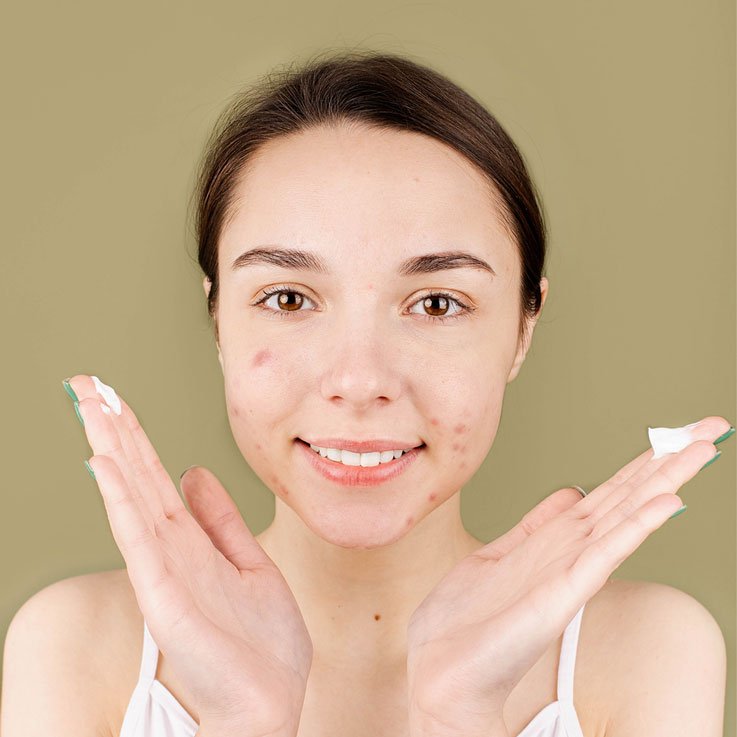
What do dermatologists recommend for acne?
Acne is a topic that generates a lot of controversy, as we all know how much dermatologists advise the Roaccutane treatment. Prior to this, obviously, the patient has generally been prescribed countless synthetic creams and/or antibiotic pills (causing deep damage to the microbiota). Seeing no results, dermatologists proceed to Roaccutane, a treatment that is tremendously aggressive for the skin and harmful to the body. Such is the effect it has on our organism that multiple blood tests are required (especially in women) to ensure that the patient is not pregnant.
Also known as the oral isotretinoin treatment or “strong acne pill”, this compound belongs to the family of oral retinoids, which are drugs derived from vitamin A.
Isotretinoin regulates the different pathophysiological processes that occur in acne, decreasing sebaceous secretion, eliminating keratin plugs, and alleviating the inflammation of lesions.

Once the compound is ingested, it must be eliminated by the liver, causing its inflammation in many cases. In addition, isotretinoin can raise cholesterol and triglyceride levels, so before starting treatment and while it lasts, it is necessary to check that the liver and blood lipids are fine and that there is no underlying disease that contraindicates it.
Its side effects, which most patients suffer, are: extreme dryness of the skin and lips, and dryness of the nasal and ocular mucosa. It also causes minor muscle discomfort in the back. In the event that a woman is pregnant, this treatment can cause teratogenicity, an anomaly that causes serious fetal malformations.
Isn't it astonishing that dermatologists continue to prescribe this totally chemical and highly harmful treatment, when there are different natural practices and tools to solve the acne problem?

Therefore, it is important, if you are a dermatologist or a future dermatologist, to study, research, test on your own skin, and try to give the best recommendations for your patients. Because their skin depends on your knowledge. Update it constantly and don't settle for what you have.
In matters of study and learning, it is important to counterbalance all types of information and create your own personal criteria, following reason, but also the heart.